The competitive landscape of global Amazon selling has shifted drastically over the last few years. In 2026, launching an eCommerce brand and simply having an adequate product is no longer sufficient to guarantee sales. If you want to dominate fiercely contested consumer niches, you require a highly sophisticated, data-driven, multi-market global selling strategy to comprehensively outmaneuver both international competitors and deeply entrenched domestic giants.
The United States (Amazon.com) and the United Kingdom (Amazon.co.uk) represent two of the absolute largest, most affluent, and most aggressively targeted digital consumer markets on the planet. For eCommerce brands, successfully scaling operations across these distinct territories can yield exponential, nine-figure revenue growth. However, this cross-border leap is fraught with immense logistical complexities, strict compliance hurdles, and algorithmic nuances that must be expertly navigated.
In this exhaustive 1,500+ word strategy blueprint, the eCommerce scaling experts at 3S-SOFT dissect the proven methodologies required for ambitious brands to shatter their revenue ceilings and definitively conquer the US and UK Amazon marketplaces in 2026.
---
The Core Foundational Pillar: Supply Chain and Inventory Domination
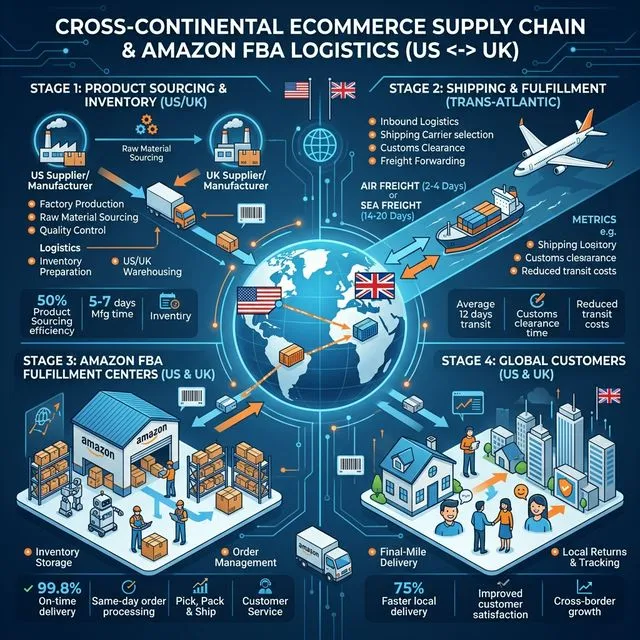
The cornerstone of any successful Amazon Empire is the absolute reliability of its logistical supply chain. The A9 (Amazon's proprietary search algorithm) ruthlessly prioritizes fast, frictionless delivery. An out-of-stock event in 2026 is mathematically disastrous; it not only halts immediate sales but severely destroys your hard-earned organic keyword rankings. Upon restocking, overcoming this algorithmic penalty can take weeks of massive PPC (Pay-Per-Click) expenditure.
#### Mastering Cross-Continental Logistics
To thrive in both the US and the UK simultaneously, brands must transcend basic shipping models.
* Strategic Split-Shipping and 3PL Integration: Relying solely on Amazon’s fulfillment centers to hold all your stock is expensive (due to massive long-term storage fees) and risky (due to Amazon’s sudden, stringent inventory limits). Elite sellers in 2026 employ massive Third-Party Logistics (3PL) warehouses positioned strategically on the US East and West coasts, as well as structurally within the UK Midlands. These 3PLs act as cheap, massive holding tanks, only drip-feeding specialized inventory directly into Amazon FBA (Fulfillment by Amazon) facilities precisely when the algorithm demands it.
* Supply Chain redundancies: True global brands never rely on a singular factory. Geopolitical shifts, sudden tariff implementations, and localized manufacturing delays demand that brands diversify their sourcing matrices. Securing secondary manufacturers in distinct regions (e.g., Vietnam, Mexico, or Eastern Europe) guarantees that your supply line to FBA never runs completely dry.
---
Hyper-Localized SEO and Content Architecture
A fatal, incredibly common mistake made by expanding brands is merely copy-pasting their American product listings directly into the UK marketplace, or vice-versa. While the countries share a language, they drastically differ in cultural vernacular, search behavior, and emotional purchasing triggers.
#### Cultural Marketing Alignment
A product listing description, an infographic sequence, or a lifestyle image that converts exceptionally well to a shopper in New York may require highly subtle yet deeply vital shifts to resonate optimally with a demographic situated in London or Manchester.
* Lexicon and Spelling Validation: Optimizing for local syntax is vital. An American consumer intimately searches for '*Sneakers*' or '*Pants*', while a UK consumer aggressively searches for '*Trainers*' or '*Trousers*'. Merely failing to adapt basic spelling conventions (e.g., *Color* vs. *Colour*, *Optimize* vs. *Optimise*) immediately signals to a UK buyer that the brand is totally foreign, significantly lowering local trust and spiking the bounce rate.
* Semantic Topic Clustering: Forget targeting deeply isolated keywords. Modern Amazon SEO requires comprehensively mapping the entire semantic web of a product. Backend search terms, structured bullet points, and the massive A+ Premium Content descriptions must accurately and fluently communicate absolute topical authority to Amazon’s Natural Language Processing (NLP) bots.
#### Visual Persuasion and Conversion Rate Optimization (CRO)
If your SEO is the engine that drives traffic, your visual content is the closer. In 2026, consumers definitively buy with their eyes.
* Professional 3D Rendering & Macro Photography: Grainy or standard iPhone photos destroy brand equity. You require immensely high-resolution, perfectly lit 3D renders that highlight microscopic product details, alongside highly aspirational lifestyle photography indicating the product in active, realistic use.
* A/B Testing Hero Images: The primary hero image (image 1) dictates your Click-Through Rate (CTR) from the search results page. Top sellers meticulously A/B test angles, lighting, and packaging presentations using external polling data to definitively find the mathematically proven highest-converting main image before fully launching.
---
Algorithmic PPC Advertising Excellence (Amazon Ads)
As the Amazon marketplaces become hyper-saturated, Cost-Per-Click (CPC) rates continue to rise sharply across virtually all major categories. 'Set it and forget it' advertising campaigns are nothing more than a rapid way to incinerate capital. Consequently, highly tactical, AI-driven algorithmic bidding strategies have now seamlessly become the unyielding industry standard.
#### Beyond Basic Auto-Campaigns
To remain profitable while aggressively stealing market share from established giants, sellers must actively transition to massively sophisticated manual advertising matrixes.
* Granular Keyword Isolation: Rather than grouping entirely different keywords into a single broad ad set, top sellers isolate high-performing, long-tail search terms into their own dedicated, single-keyword campaigns. This grants absolute, surgical control over the precise exact-match bid and specific ad placement (Top of Search vs. Product Pages).
* Automated Day-Parting and Bid Adjustments: Consumer purchasing intent fluctuates wildly depending upon the precise hour of the day. Integrating AI software that automatically increases bids heavily during peak evening shopping hours (when Conversion Rates are astronomical) and severely lowers bids during the early morning hours drastically reduces wasted ad spend and vastly improves Return on Ad Spend (ROAS).
* The Power of Sponsored Display & DSP: Standard Sponsored Product ads are vital, but conquering the market requires ubiquitous visibility. Utilizing Amazon’s highly advanced Demand-Side Platform (DSP) allows brands to aggressively retarget consumers who viewed their listings but did not purchase, displaying highly persuasive banner ads to those exact consumers across completely external websites (like ESPN or the Washington Post), effectively pulling them back into the Amazon funnel.
---
External Traffic and Omnichannel Velocity Signals
While heavily optimizing entirely within the Amazon ecosystem is critical, the true secret weapon of multi-million dollar brands in 2026 is strategically manipulating aggressive *external* traffic.
Amazon inherently loves external brands that spend their own hard-earned marketing dollars to actively drive fresh, high-intent traffic directly onto the Amazon platform entirely from the outside web. Amazon drastically rewards this external behavior with massive, sustained boosts to organic ranking momentum.
#### Designing an Inbound Traffic Engine
* Social Media & Micro-Influencer Syndication: Driving highly qualified, heavily segmented external traffic natively from fast-paced social platforms (primarily TikTok, YouTube Shorts, and Instagram Reels) acts as a massive rocket booster for your internal Amazon Best Seller Rank (BSR). Partnering intricately with hundreds of micro-influencers to organically demonstrate the product creates an undeniable tsunami of highly motivated, high-converting traffic.
* The Power of the Amazon Attribution Tag: Historically, executing Facebook Ads direct-to-Amazon was risky because conversion tracking was entirely dark. Now, by exclusively utilizing Amazon Attribution Tags, brands can strictly measure the exact fractional ROAS generated from specific Google and Meta ad sets, and accurately claim the lucrative 10% Brand Referral Bonus provided by Amazon.
---
The 3S-SOFT eCommerce Management Advantage
Global Amazon expansion is definitively not a side-project; it requires an army of specialists. A lone founder attempting to single-handedly manage dynamic inventory pipelines, aggressive daily PPC bid optimization, constant visual content creation, and fierce competitor analysis will quickly burn out or fatally mismanage cash flow.
At 3S-SOFT, our devoted eCommerce architects operate directly as a highly potent extension of your internal operations team. We meticulously manage intensely complex, high-velocity Amazon FBA portfolios for elite corporate clients worldwide, structurally focusing on maximizing revenue and strictly minimizing ACoS (Advertising Cost of Sales).
#### Comprehensive Data-Driven execution
Our approach is severely analytical. We actively deploy immensely deep competitor audits to locate severe vulnerabilities in their listing structures. We aggressively engineer automated advertising strategies, continuously monitor backend ranking velocity, and deploy rigorous, multivariate listing optimization tests to ensure our clients capture and eternally maintain the absolute top-page dominance they require to command their niche.
Whether you are a highly successful US-based brand aggressively eyeing the lucrative European theater, or an entrenched UK domestic seller plotting to fully infiltrate and conquer massive North American demographics, we provide the absolute structural expertise and ruthless execution required to forge a true, untouchable global eCommerce empire.
Tags