The MERN stack (MongoDB, Express.js, React, Node.js) continues to be the absolute bedrock of modern, scalable web development in 2026. For technology startups, enterprise visionaries, and robust SaaS platforms looking to scale their digital infrastructure quickly while maintaining a clean, highly maintainable codebase, MERN offers an unparalleled, open-source ecosystem. In an era where performance dictates user retention, choosing the right tech stack is your first major business decision as a founder.
In this comprehensive, 1,500+ word guide, we will break down exactly why the MERN stack is the optimal choice for modern startups, exploring the depths of its architecture, its massive scalability advantages, the future trajectory of its individual components, and how elite agencies like 3S-SOFT leverage it to build world-class, enterprise-grade applications.
---
What Exactly is the MERN Stack?
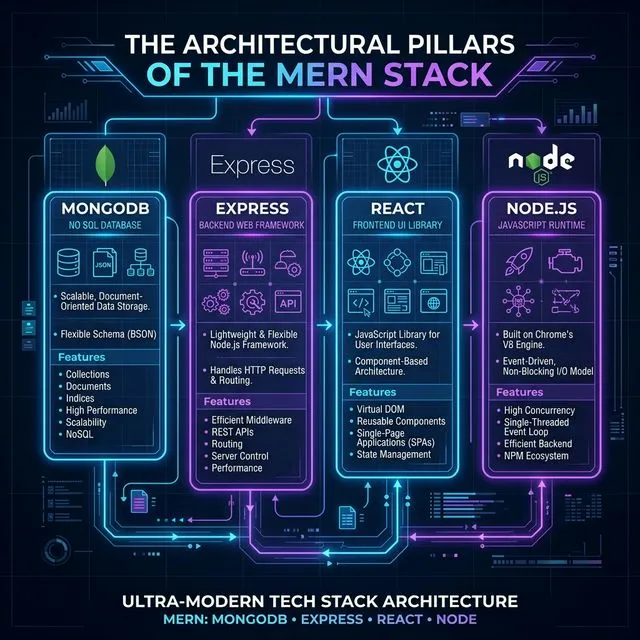
Before diving into its commercial advantages, it is critical to understand the technical anatomy of the MERN stack. Unlike older legacy stacks like LAMP (Linux, Apache, MySQL, PHP), MERN is composed entirely of JavaScript (and typescript) from top to bottom. This singular language dependency is the foundational key to its massive popularity.
#### 1. MongoDB (The Database Layer)
At the base of the stack lies MongoDB, a highly popular NoSQL, document-oriented database. Unlike relational databases (like PostgreSQL or MySQL) that store data in rigid tables and rows, MongoDB stores data in flexible, JSON-like documents (specifically BSON).
* Schema Flexibility: Startups often pivot. Your data model on day one will rarely look like your data model on day 300. MongoDB allows developers to manipulate the schema drastically without requiring massive, risky database migrations.
* Horizontal Scalability: Through a process called 'sharding', MongoDB can distribute massive troves of data across hundreds of servers concurrently, ensuring that as your user base explodes from 1,000 to 1,000,000 users, your database doesn't become the bottleneck.
#### 2. Express.js (The Backend Framework)
Express.js sits on top of Node.js. It is a minimal, beautifully unopinionated web framework designed specifically for building robust APIs and web applications.
* Middleware Mastery: Express shines in its use of middleware. Developers can easily inject custom or third-party logic into the request-response cycle. Need to add JWT authentication, logger tools, or CORS configurations? Express handles this with a simple `.use()` function.
* Routing Efficiency: Building RESTful or GraphQL endpoints is incredibly straightforward with Express, allowing frontend teams to interface with server data seamlessly and securely.
#### 3. React.js (The Frontend Interface)
React, originally developed by Meta, remains the undisputed champion of the modern front-end wars in 2026. It is a declarative, component-based JavaScript library used exclusively for building phenomenal user interfaces.
* The Virtual DOM: React's revolutionary approach to rendering involves the Virtual DOM. Instead of re-rendering the entire webpage when a user interacts (which is incredibly slow), React calculates the exact differential changes in memory, and specifically updates only the changed pixels on the screen.
* Reusability at Scale: A UI consists of buttons, navbars, forms, and cards. React allows developers to build these once as isolated components and reuse them infinitely, drastically reducing code bloat and maintaining a highly consistent design system.
* Server Components in 2026: With the advent of React 19 and deep integrations with frameworks like Next.js, React now heavily utilizes Server Components, allowing massive portions of the UI to be rendered server-side. This results in blindingly fast initial page loads and massive SEO benefits—a critical metric in modern Google algorithms.
#### 4. Node.js (The Application Runtime)
Node.js wraps it all together. It is a cross-platform backend runtime environment built entirely on Chrome's ultra-fast V8 JavaScript engine.
* Event-Driven & Non-Blocking: Traditional servers typically spin up a new, highly resource-intensive 'thread' for every single user request. Node.js operates on a single-threaded 'event loop' utilizing non-blocking I/O. This means that a single Node instance can effortlessly handle tens of thousands of simultaneous, concurrent connections without crashing.
* The Power of NPM: Node comes with the Node Package Manager (NPM), providing developers with immediate access to millions of pre-written, highly tested libraries. Why write a payment gateway integration from scratch when you can simply `npm install stripe`?
---
Why the MERN Stack Absolutely Dominates in 2026
The shift towards MERN is not just a trend; it is a structural evolution in software engineering physics. Here is a deep dive into why enterprise architects continue to choose MERN.
#### The Magic of Full-Stack JavaScript Synergy
In a fragmented stack (for example: a Django Python backend communicating with a Vue frontend via a MySQL database), you require specialized developers. You need a Python expert, a SQL database administrator, and a Vue specialist. This drastically inflates payroll, slows down communication, and limits agility.
By utilizing a single, universal language—JavaScript (or increasingly, TypeScript)—across the entire stack, the development cycle is radically simplified.
* Universal Engineering: A developer working on the backend API can seamlessly jump to the frontend code to fix a UI bug, because the syntax, the logical structures, and the tooling are identical.
* Code Sharing: Validation logic (e.g., ensuring an email address is valid format) can be written exactly once and shared natively between both the client-side form and the backend server verification.
#### The SEO and Performance Superiority
Search engine optimization in 2026 demands near-instantaneous page-load times (measured strictly via Google's Core Web Vitals) alongside deeply semantic HTML context. While early Single Page Applications (SPAs) struggled with SEO, the modern MERN stack—specifically when augmented by Meta-frameworks like Next.js—completely solves this.
By utilizing Server-Side Rendering (SSR) and Incremental Static Regeneration (ISR), React can ship fully formed, highly crawlable HTML files instantly to Google's search bots, resulting in massive visibility jumps while maintaining the snappy, app-like feel of a client-side application once the javascript hydrates.
#### The Ecosystem and Global Talent Pool
The size of a technology community is a direct indicator of its viability. The JavaScript ecosystem is the largest in the world. For a rapidly growing startup or a US/UK corporation looking to offshore technical capacity, this is crucial. Finding elite engineers who specialize in MERN is significantly more viable, and the massive community support ensures that any complex problem you encounter has likely already been solved, documented, and published to StackOverflow or GitHub.
---
Scaling Your Application: From MVP to Enterprise Behemoth
Building a functioning application is step one. Ensuring that application does not collapse under the weight of 500,000 active users is the true challenge. The beauty of the MERN stack is that it allows for extremely rapid MVP prototyping while retaining the architectural architecture necessary for infinite horizontal scaling.
To truly master application scaling in 2026, tech leaders must look beyond the basic four components of the stack. A mature MERN architecture heavily implements several external orchestration tools:
#### 1. In-Memory Caching (Redis)
If your application queries the MongoDB database for the exact same information 10,000 times a minute (e.g., pulling the top 10 most popular products), your database will choke. Implementing Redis—a lightning-fast, in-memory data store—allows your Express server to cache this data. Subsequent requests bypass the database entirely and pull from Redis memory in sub-milliseconds.
#### 2. Containerization (Docker)
'It works on my machine but breaks in production' is a phrase that has cost businesses millions in lost productivity. Docker solves this by heavily containerizing the application. It packages the Node server, the React build, and the database logic into isolated, reproducible digital shipping containers. Whether this container is run on a developer’s Macbook in Chittagong or an AWS server in Virginia, the environment is perfectly identical.
#### 3. Orchestration (Kubernetes)
As traffic spikes exponentially (e.g., during a massive viral marketing campaign or a Black Friday sale), a single server will inevitably fail. Kubernetes (K8s) is an orchestration system that monitors server load dynamically. If traffic surges, Kubernetes will automatically spin up multiple new, cloned 'pods' of your Node application across different servers to distribute the weight. When traffic subsides, it kills the pods to save on cloud commuting costs.
#### 4. The Microservices Pivot
In the beginning, most MERN apps are completely 'Monolithic' (all backend code lives in one massive file structure). This is great for speed. But as the application reaches enterprise tier, the MERN stack allows you to safely cleave the application into distinct 'Microservices'. Your payment processing API becomes a separate Node instance from your user authentication API. This means if the payment gateway crashes, the entire application does not go down with it.
---
The 3S-SOFT Engineering Advantage
At 3S-SOFT, we do not merely function as coding contractors—we operate as specialized, high-tier architectural engineers. Our core mission is taking bespoke MERN applications from initial concept scaling all the way to massive, enterprise-ready status.
We specialize in strictly typed TypeScript/MERN environments, ensuring that codebase errors are heavily caught at compile-time rather than crashing in the user’s browser. We build with an unwavering Architecture-First mindset. Before a single RESTful endpoint is established, our senior systems architects map out the entire database relationship diagram and cloud AWS infrastructure.
Whether you are a highly disruptive SaaS startup seeking seed funding in London, or a deeply entrenched enterprise modernizing your infrastructure in the USA, our elite teams based in Chittagong, Bangladesh provide the technical firewall needed to guarantee success. We adhere to rigorous US and UK industry methodologies for code hygiene, automated CI/CD deployment pipelines, complex cybersecurity protocols, and sophisticated project management communication.
Key Takeaways for Founders and CTOs
If you are charting the technical trajectory of your business in 2026, the data is clear:
* Speed to Market: MERN allows teams to build highly complex features in mere fractions of the time compared to compiled, heavier languages like Java or C#.
* Avoid Technical Debt: Starting with a modular, highly decoupled MERN architecture prevents the extremely painful necessity of totally rewriting your backend codebase three years down the line when data structures change.
* Invest in APIs Early: Ruthlessly focus on building modular, DRY (Don't Repeat Yourself) RESTful or GraphQL APIs early in the lifecycle. Doing so ensures extreme long-term scalability and provides the immediate flexibility necessary for future mobile iOS/Android app integrations (using React Native, which intimately shares the React.js syntax).
The MERN stack is not just a collection of technologies; it is an aggressive ideology centered around speed, agility, and unmatched user experiences. Partnering with a proven technical agency like 3S-SOFT ensures that your MERN investment converts directly into unshakeable digital market dominance.
Tags