React has completely monopolized the enterprise frontend ecosystem. In 2026, simply knowing how to initialize a `useState` hook or map over an array is barely sufficient for junior-level roles. Building applications that scale to millions of concurrent users—without the browser thread choking on massive DOM repaints—requires an intense, masterful command over Advanced React Patterns and microscopic performance optimization techniques.
When users interact with a modern SaaS dashboard or a dynamic Next.js eCommerce storefront, they expect absolute, 60fps (frames per second) fluidity. Even a 250-millisecond rendering stutter can utterly destroy the illusion of native app performance, causing frustration, spiking bounce rates, and mathematically damaging your Google Core Web Vitals rankings.
In this exhaustive 1,500+ word technical deep-dive, the elite frontend architects at 3S-SOFT systematically break down the advanced React rendering patterns, component architectures, and ruthless memory management techniques required to build blazing-fast, enterprise-scale web applications in 2026.
---
Understanding the Reconciliation Engine
Before you can effectively optimize React, you must intimately understand what React is actually doing beneath the abstraction layer.
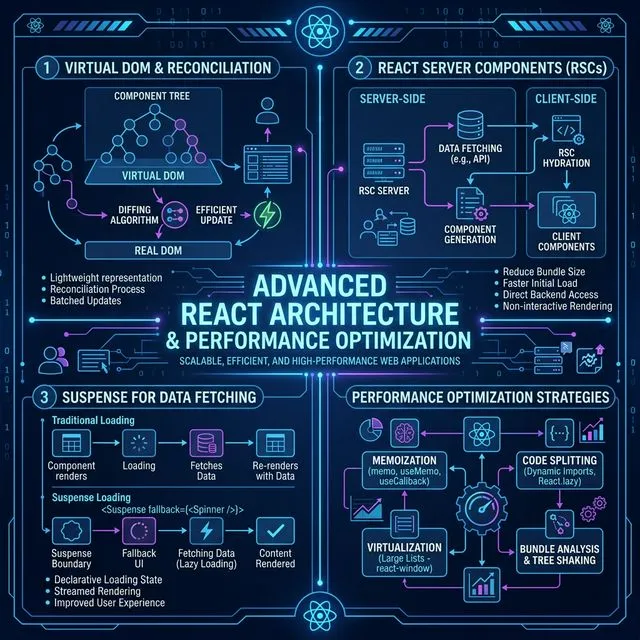
React does not interact directly with the physical Document Object Model (DOM) on every state change because writing to the physical DOM is notoriously, incredibly slow. Instead, React maintains a deeply complex JavaScript object representation of the DOM—the Virtual DOM.
* The Render Phase: When a component’s state or props change, React violently executes the component function, effectively 'drawing' a brand new Virtual DOM tree in memory.
* The Commit Phase: React then executes a highly optimized diffing algorithm (Reconciliation) to compare the brand new Virtual DOM tree against the previous Virtual DOM tree. It calculates the mathematically absolute minimum number of mutations required, and physically 'commits' only those specific, microscopic changes to the actual browser DOM.
The inherent performance trap lies precisely in the Render Phase. If you manage state poorly at the top level of your application, React will needlessly 're-draw' thousands of deeply nested child components in memory, causing massive JavaScript thread blockage, even if the physical DOM ultimately doesn't change.
---
Conquering Unnecessary Re-Renders
The most common, catastrophic performance flaw in monolithic React applications is the cascading re-render problem.
#### State Colocation (Moving State Down)
If you place a `setSearchQuery` state variable at the very top of your global `App.jsx` simply because two disparate components need it, every single keystroke typed into the search bar will aggressively trigger a re-render of your *entire* application—including massive data tables and complex charts that have absolutely nothing to do with the search input.
* The Solution: The golden rule of React architecture natively dictates that state should absolutely live as close as mathematically possible to where it is physically consumed. By severing the search input into its own isolated component and housing the state there, only the tiny search component re-renders on keystroke, completely saving the broader application tree.
#### The `React.memo` Abstraction
When state absolutely *must* live high in the tree (for instance, global user authentication logic), you must mathematically protect the heavy downstream UI components from inheriting unnecessary renders.
* Memorization: Wrapping a massive, computationally expensive child component (like a heavy D3.js data visualization graph) inside `React.memo()` explicitly tells the React engine: *"Do not re-render this component unless its specific, incoming primitive props have mathematically changed."* This is a vastly powerful shield against the cascading rendering waterfall.
---
Advanced Hooks and Referential Equality
JavaScript fundamentally evaluates object and function equality by *reference*, not by *value*. Every time a parent component re-renders, any standard functions or array arrays defined inside that parent are completely destroyed and recreated with brand-new memory addresses. This breaks `React.memo` entirely, as the child component perceives the 'new' memory address as a mutated prop.
#### Mastering `useCallback` and `useMemo`
To prevent massive reference regeneration, senior engineers deploy the twin optimization hooks.
* `useCallback`: This hook aggressively memorizes the exact, physical memory address of a function across renders. If you are passing an `onDeleteClick` handler down three levels deep into a perfectly memoized button component, you *must* wrap the parent function in `useCallback` to prevent the button from needlessly re-rendering.
* `useMemo`: If your component mathematically filters a massive array of 50,000 JSON records, doing so directly in the render body will maliciously stall the thread. Wrapping that massive computation inside `useMemo` guarantees that the expensive calculation only runs exclusively when the specific dependency array physically changes.
---
The Architecture of the Future: Server Components
The absolute biggest paradigm shift in the history of React dropped heavily with the widespread adoption of deeply integrated React Server Components (RSC), driven aggressively by Meta-frameworks like Next.js 14 and 15 utilizing the App Router architecture.
#### Client vs. Server
Historically, React sent a massive bundle of JavaScript to the user's browser, forcing the user's phone or laptop to laboriously construct the UI entirely on the client side (CSR).
* Zero-Bundle Architectures: React Server Components allow developers to build components that render exclusively on an ultra-fast backend server. Because the server constructs the final HTML, the actual JavaScript logic powering the component is completely stripped from the final bundle sent to the client. This results in incredibly massive reductions in Time to Interactive (TTI) and First Contentful Paint (FCP).
* The Interleaving Pattern: Senior architects now structure applications by heavily wrapping massive Server Components (which securely fetch data directly from the adjacent database with zero latency) completely around microscopic, highly optimized Client Components (which handle strictly necessary interactivity, like an `onClick` animation).
---
Concurrent Features and Suspense
In 2026, forcing a user to stare at a completely white screen while a massive API call resolves is completely unacceptable UX design. Modern React handles asynchronous logic beautifully through explicit Concurrent architecture.
#### `React.Suspense` for Fluid UX
By aggressively wrapping complex, data-fetching components inside `<Suspense fallback={<Skeleton />}>`, the React engine will automatically render a beautiful, highly animated skeleton UI structure in its exact place while the data is retrieved. This allows the surrounding application (like the persistent navbar and sidebar) to render instantly, maintaining user engagement.
#### The `useTransition` Hook
If a user clicks a button to physically swap between a 'Dashboard' view and a massively heavy 'Analytics' view, the main thread may choke trying to draw the massive analytics graphs.
By wrapping the state update inside `startTransition()`, you are explicitly informing the React engine that this massive render is of low priority. React will keep the UI fully interactive and responsive, physically interrupting its own rendering process if the user types or clicks somewhere else unexpectedly.
The 3S-SOFT Frontend Advantage
Building simple React components is trivial; architecting massive, mathematically optimized, 100,000-line React codebases that scale globally is an elite engineering discipline.
At 3S-SOFT, our senior frontend architects do not rely on basic functionality. We painstakingly audit component waterfalls utilizing the React Profiler API. We execute aggressive code-splitting at the precise route level using dynamic imports. We strip heavy libraries (like huge monolithic charting packages) and utilize native Web APIs to shave crucial milliseconds off the load time.
Whether you are seeking to completely modernize a struggling, sluggish legacy SPA into a blazing-fast Next.js architecture, or require an elite, dedicated frontend team to structurally guarantee your new SaaS startup launches with zero performance bottlenecks, 3S-SOFT provides the absolute bleeding-edge technical prowess required to command your audience.
Tags